Alibaba Cloud’s Application Real-Time Monitoring Service (ARMS) documentation lists a product rename and console change effective July 30, 2026. LLM Application Monitoring is now called AI Agent Observability, and its console access path is routed to Cloud Monitor 2.0. This is not a new model launch. It is a repositioning of the monitoring surface around AI agents, models, tools, and the full execution workflow.
The official timeline says data migration was completed silently on June 1, while the name and console route changed on July 30. The documentation says existing user data will be migrated automatically, with no code or configuration changes required, and that the billing model is unaffected. Users should still check the updated console path against their own region, account, and entitlements.
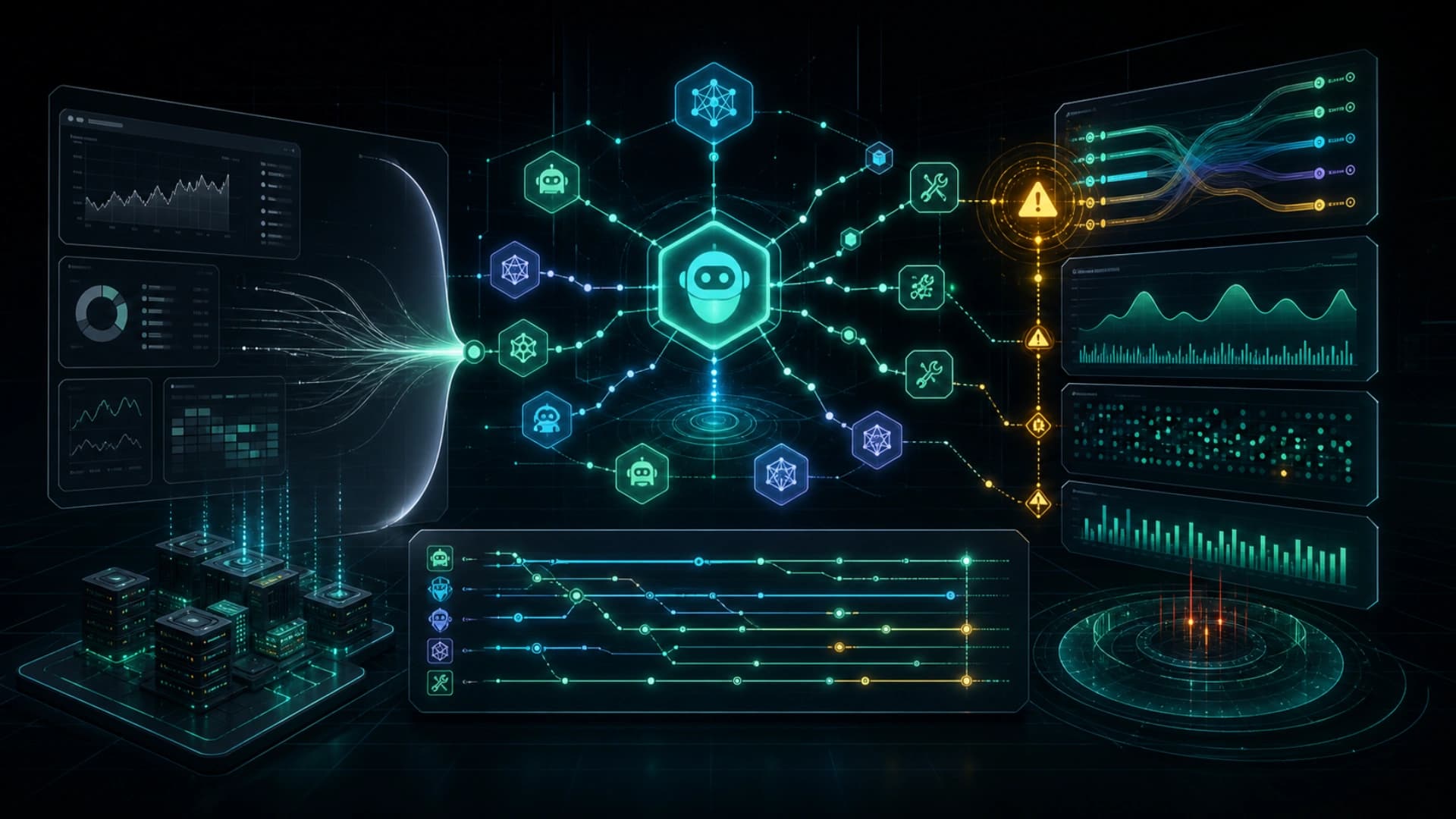
The main signal is that the system’s unit of observation is getting broader. ARMS lists global topology and health monitoring for AI applications, agents, models, tools, and other observable entities, including their dependencies and health status. For a multi-tool, multi-model agent workflow, that is closer to the system teams need to operate than a view of one API response at a time.
Trace analysis covers agent reasoning and execution paths with trace trees and trace diagrams. The documentation says multimodal data support is still in preview. Session analysis reconstructs user-to-agent interactions from the user’s perspective, including multi-turn and long-running sessions. Together, these views can help engineers move from an individual failure to the step, tool, or model that caused downstream effects.
The product also lists scenario-specific dashboards for token usage, model performance, tool invocations, and user behavior analysis. Alerting covers model invocations, tool invocations, token consumption, and agent self-invocations, with intelligent analysis and root-cause identification for agent anomaly alerts. These are capabilities described in Alibaba Cloud’s documentation, not an independent evaluation of accuracy or availability for every account and region.
That scope reflects the operational problem that appears after agents go live. Teams need to know not only whether a model answered correctly, but also which tools it used, how many tokens it consumed, which session branch became abnormal, and whether the issue propagated through dependencies. Without topology, traces, sessions, and cost views, long-running or multi-agent workflows are often debugged from incomplete chat transcripts.
The rename does not by itself solve reliability, security, or governance. Teams still need policies for data retention, sensitive-content masking, trace access, cost alerts, human escalation, and rollback. They also need to confirm that migrated data is complete in the live console. Alibaba Cloud’s document describes product scope and upgrade impact; it is not an independent performance or quality assessment.
The practical interpretation is that Alibaba Cloud is turning agent observability from an LLM monitoring label into a broader control surface for topology, workflow execution, and operational alerts. For teams moving agents into production, that visibility layer belongs alongside permissions, evaluation, cost controls, and human approval—not as an afterthought after an incident.