
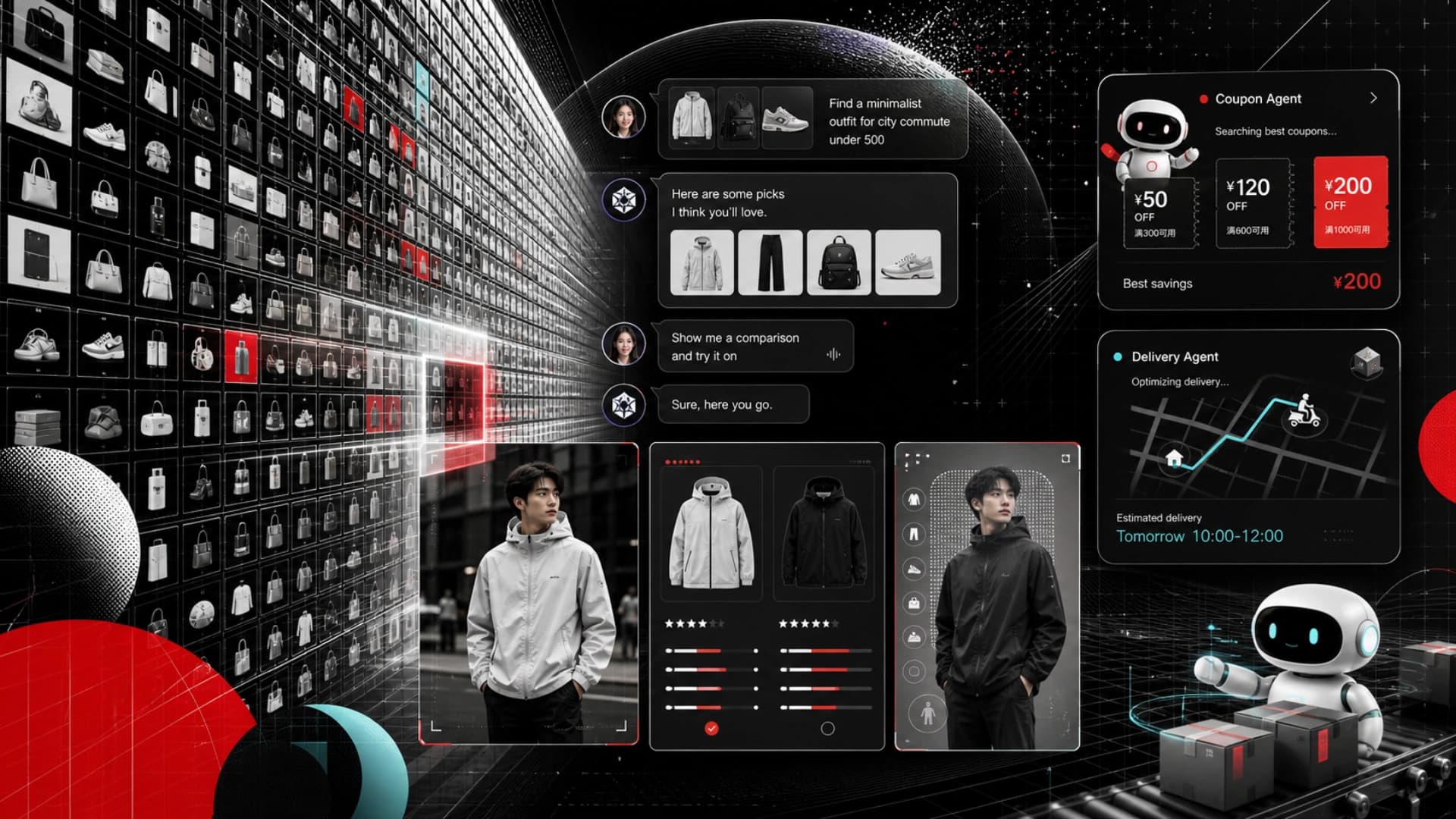
On May 11, 2026, Alibaba announced that it had fully connected the Qwen App to Taobao's product catalog and launched a Qwen-powered shopping assistant inside the Taobao App. This is one of the clearest AI commerce signals of the month because it is not just a chatbot on an ecommerce page. It joins conversation, product understanding, ordering, and after-sales workflows into one agentic shopping path.
Alibaba says users in China can now browse, compare, place orders, and manage deliveries through natural conversation instead of keyword search. Qwen App gains access to the full Taobao and Tmall catalog of more than 4 billion products, backed by AI agents with a skills library for order management, logistics, and after-sales service. That moves Qwen closer to the transaction layer, not only the recommendation layer.
The key shift is that shopping starts with an open-ended question rather than a search bar. A user can say they want to buy a gift after receiving a first paycheck, and Qwen can ask follow-up questions about budget and style before suggesting options. Someone decorating a small apartment can ask how to make the space feel larger, and Qwen can return a product bundle with practical styling notes. Agentic shopping turns requirement clarification into part of the workflow.
The new Qwen Shopping Assistant inside Taobao is also important. Trained on Taobao's full product catalog and large volumes of customer reviews, it can answer shopping questions across many scenarios and provide side-by-side comparisons. When AI can understand products, reviews, pricing, discounts, and preferences, the boundaries between search, shopping guidance, and customer service start to blur.
Alibaba is also bringing multimodal capability into the shopping flow. AI Virtual Try-On can simulate how a garment looks on a user's photo, including fabric texture and drape, with expansion planned for footwear and accessories. The value is not just novelty. It moves AI from text-based shopping assistance into visual decision support.
Discounts and post-purchase work are part of the same direction. The assistant can aggregate platform discounts during events such as 618 and recommend coupon combinations at checkout. A 30-day price tracker can place an order automatically when a target price is reached. These features move agents from what to buy toward when to buy, how to buy, and what happens after purchase.
On the merchant side, Alibaba is also upgrading Dianxiaomi, its customer-service AI for merchants, with the goal of replacing scripted chatbot replies with AI agents that can handle complex conversations and close sales. Agentic commerce is therefore not only a consumer interface shift. It also changes merchant support, conversion, and after-sales operations.
The central signal is that ecommerce is moving from keyword matching toward intent execution. When Qwen can operate across Taobao's catalog, reviews, discounts, logistics, and pre-payment confirmation, AI agents start to enter the actual consumer transaction flow. The next ecommerce competition may be less about inventory size and more about who can turn an unclear user need into a reliable, controlled, completed purchase.