
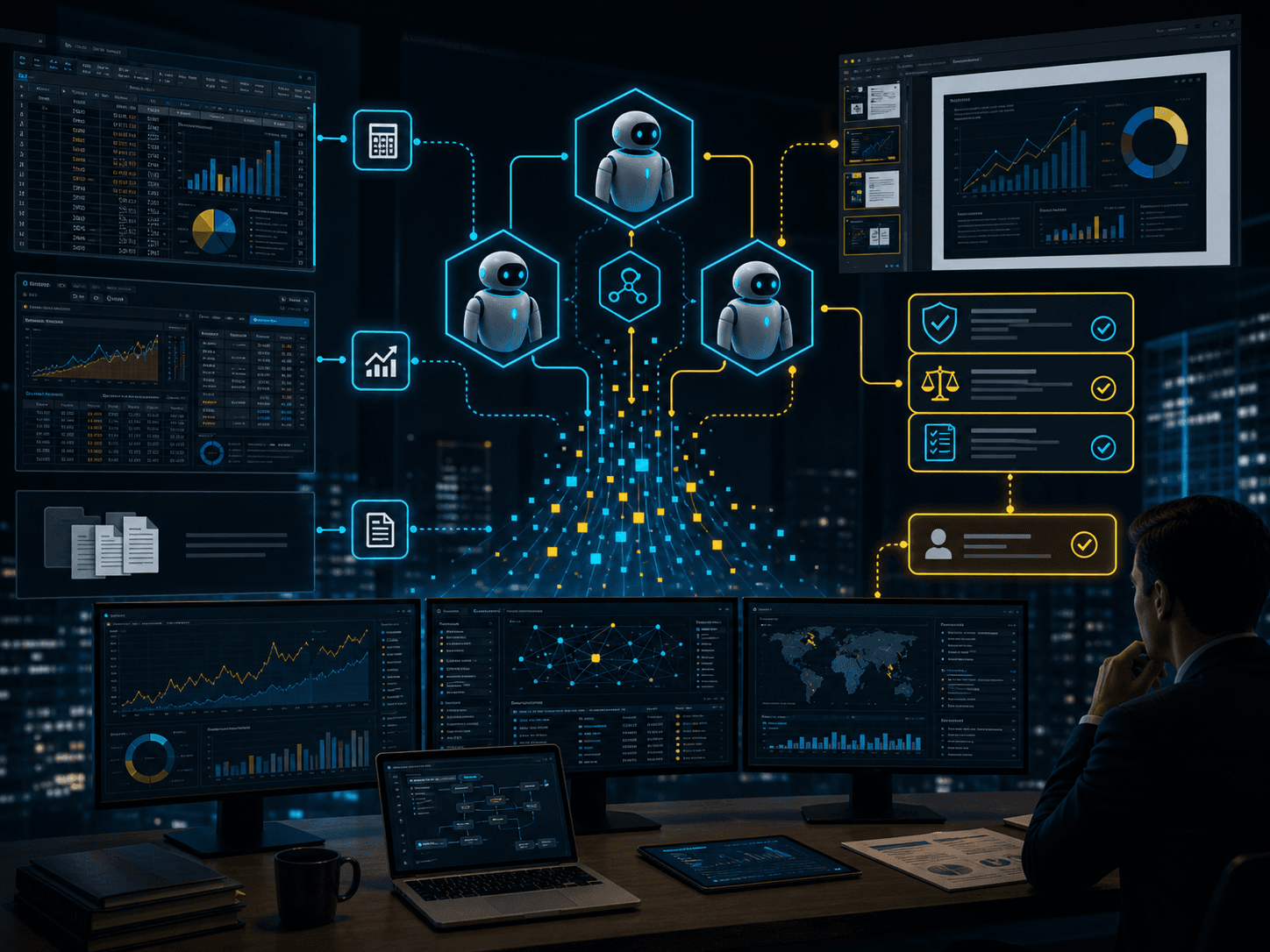
On May 5, 2026, Anthropic announced a set of financial-services agent updates built around ten ready-to-run agent templates. On the surface, this looks like a vertical package for one industry. The deeper signal is that Claude is moving from a general-purpose model into an operating layer that can sit inside professional workstations and regulated workflows.
The list of workflows is concrete: pitch builder, meeting preparer, earnings reviewer, model builder, valuation reviewer, month-end closer, statement auditor, and KYC screener, among others. These are not lightweight writing tasks. They are formal business processes involving models, decks, approvals, documents, and compliance. That matters because it shows the agent market shifting from general productivity toward vertical workflow automation.
Anthropic is also deploying the same templates across Claude Cowork, Claude Code, and Claude Managed Agents. The first two let the agent work alongside an analyst in desktop software. The managed-agent path lets the same kind of workflow run autonomously on the platform for long-running, overnight, or portfolio-scale execution. That dual model is important because it gives companies a path from human-in-the-loop assistance toward more autonomous operations.
Another major part of the announcement is Microsoft 365 coverage. Claude now works across Excel, PowerPoint, Word, and Outlook add-ins. This is more than interface integration. It lets task context carry across applications. An analyst can start in Excel, move into PowerPoint for a pitchbook, then prepare a cover note in Outlook without restating the situation at each step. That kind of context continuity is a missing layer in many enterprise workflows.
Anthropic is also expanding connectors and an MCP app so agents can work with governed access to systems such as FactSet, PitchBook, LSEG, Morningstar, Moody's, and internal enterprise data. This is critical because the real limiting factor for enterprise agents is often not model quality. It is whether the agent can reach the right data, operate under permissions, and leave a usable audit trail.
Just as important, Anthropic does not frame these agents as fully replacing people. The announcement explicitly says users remain in the loop, reviewing and approving Claude's work before anything goes to a client, gets filed, or triggers action. For regulated industries, that is a mature design choice. The goal is not to remove people from accountability. It is to remove time spent on repetitive collection, checking, and formatting work.
Even for companies outside finance, the launch is a useful reference architecture. It shows what a serious enterprise agent stack now looks like: task-specific skills, connectors, subagents, tool permissions, credential management, long-running sessions, audit logs, and clear approval points. That same structure can be mapped to sales, customer service, marketing reporting, quoting, and internal knowledge workflows.
Anthropic's update underlines a broader market shift. The competition is no longer only about which model answers best. It is about who can embed agents earliest into real workstations, real data systems, and real responsibility chains. When Claude can work continuously across Excel, PowerPoint, Outlook, and governed data sources, the market is moving from demo mode to workflow infrastructure mode.