
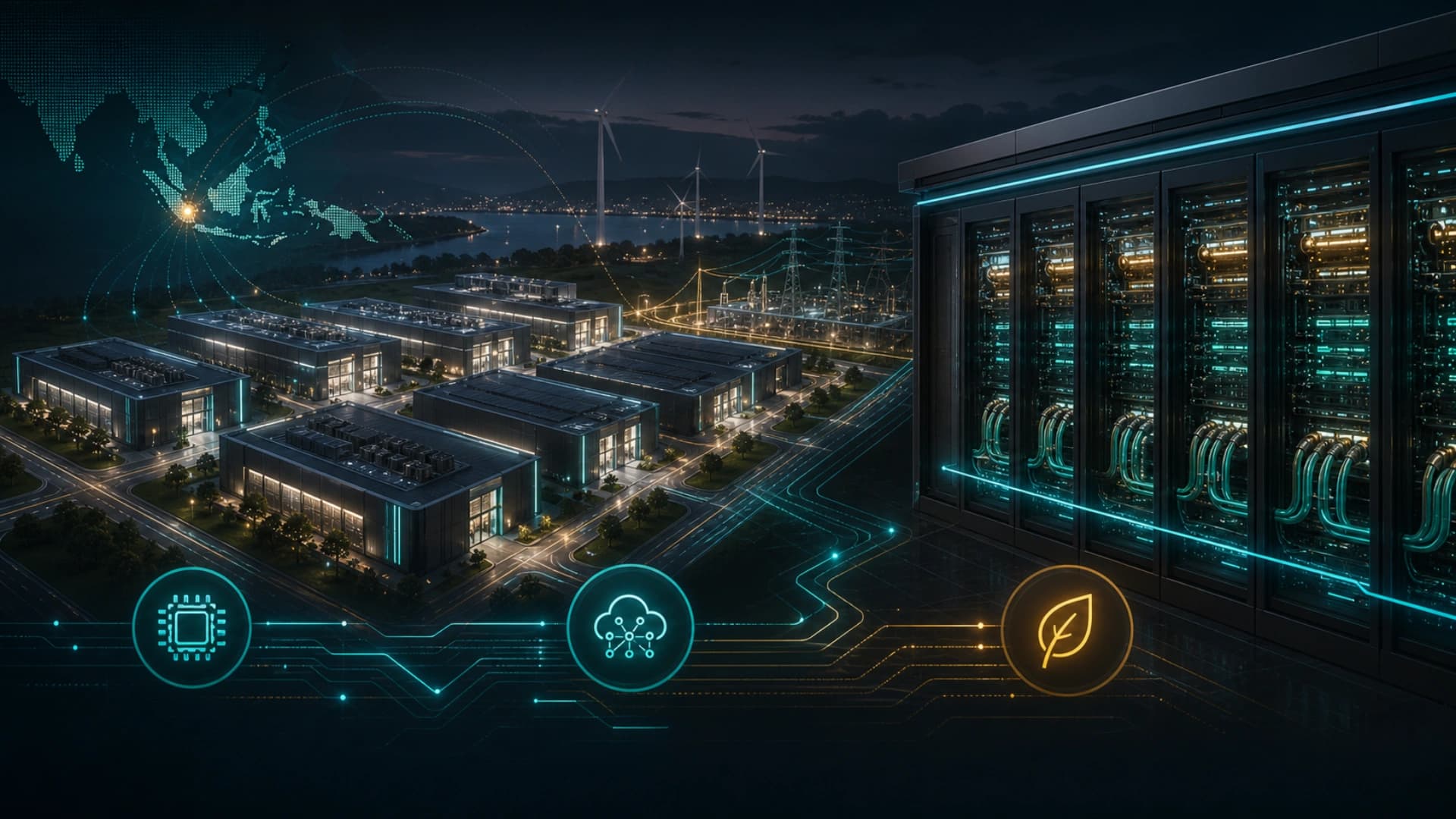
Firmus announced on June 28, 2026 that it has entered a strategic compute partnership with NVIDIA running through 2034. The anchor project is a dedicated 360MW NVIDIA DSX AI Factory campus in Batam, Indonesia. The agreement covers up to 170,000 NVIDIA AI accelerators across Grace-Blackwell, Vera-Rubin, and Vera platforms through 2027 and 2028.
This is more than a data center announcement. The important detail is the structure. Firmus will sell NVIDIA-powered cloud services to AI-native, enterprise, and ISV customers. NVIDIA will receive standard product revenue and a share of cloud revenue on supported capacity. In other words, NVIDIA is not only selling hardware. It is attaching itself to long-term AI compute usage.
Firmus frames the campus as a compute access path for global AI-native customers. These companies grow quickly and run fast-changing model and agent workloads, but they may not be able to contract hyperscaler-scale infrastructure upfront. If the revenue-sharing and credit-support model works, smaller high-growth AI companies could get more dependable access to GPU capacity.
Batam is also strategically important. It sits close to Singapore, but with different land, power, and campus construction conditions. As AI compute demand rises across Asia-Pacific, infrastructure will spread toward locations that can support dense power, cooling, and regional network access. Batam may become part of that regional AI compute layer.
Firmus also says it expects US$25 billion to US$30 billion from committed offtake agreements during the first six years of the partnership. That is the company's projection and still needs validation through customer disclosure and real capacity utilization. But the direction is clear: AI infrastructure is moving from "who has GPUs" toward "who can provide predictable cost, stable capacity, and long-term supply."
For the AI agent and workflow market, infrastructure deals like this matter. Agents are not single inference calls. They plan, read files, call tools, validate, retry, and report across multiple steps. As companies embed agents into daily work, inference demand becomes a sustained workload rather than isolated requests. Stable compute access affects pricing, latency, and reliability.
The practical takeaway is that AI-native companies increasingly need to manage infrastructure certainty like an industrial input. Model quality still matters, but compute procurement, energy efficiency, tokens per watt, regional availability, and supply contracts are becoming part of AI product competitiveness.