
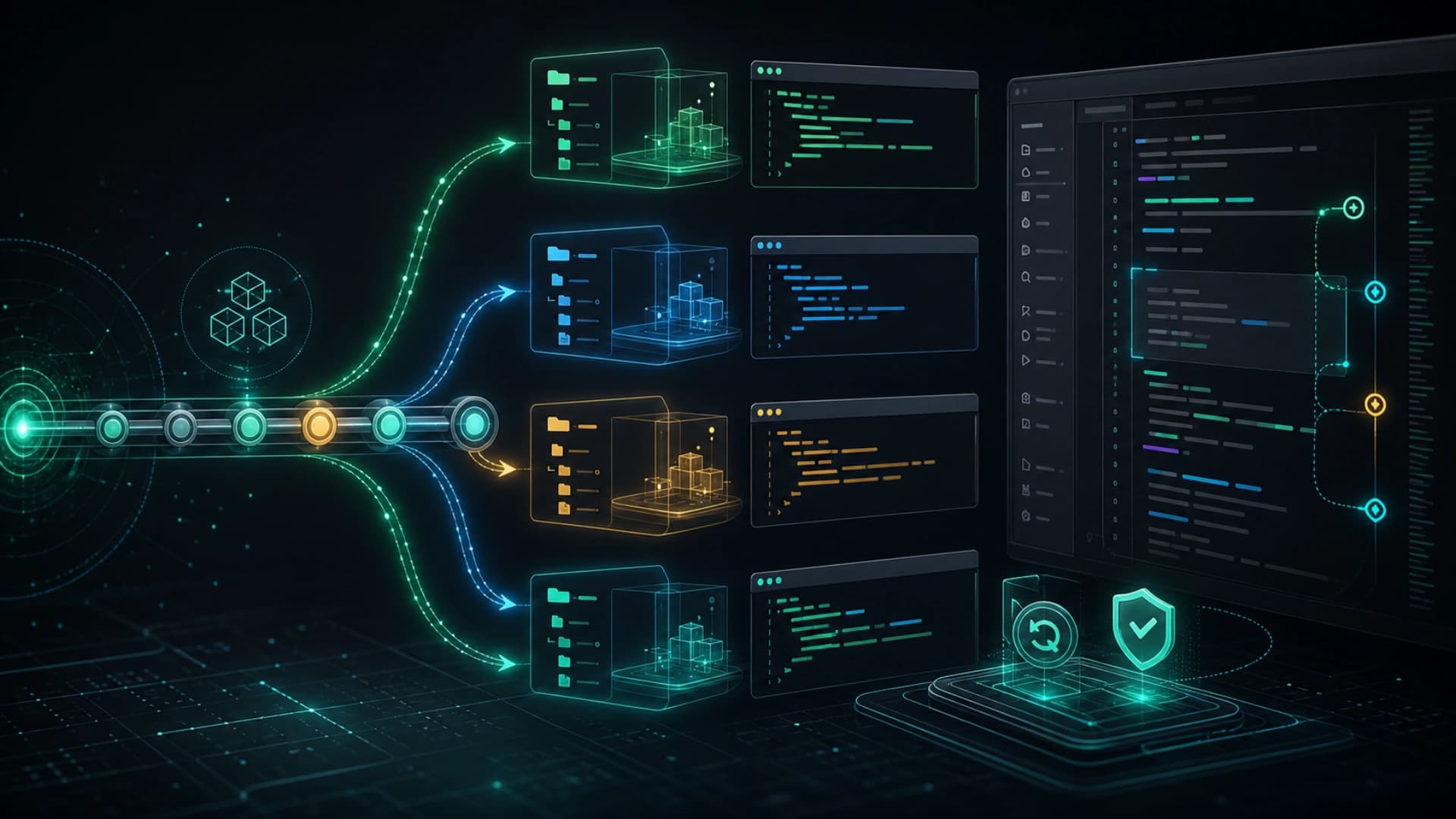
On August 7, 2026, GitHub published a Copilot weekly release roundup covering the Copilot app, Copilot CLI, and VS Code. The common thread is not one new model. It is better context handling, isolation, recovery, and feedback for longer agent-assisted development tasks.
The Copilot app now shows which model handled each request, along with AI credit and cache details. Users can move more quickly to shared sessions and use /side to ask a parallel question without interrupting the main conversation. These signals make model paths and usage easier to inspect, but they do not explain every result; tool output and the resulting code still need review.
Copilot CLI adds a sessions sidebar for managing concurrent sessions. Its experimental /worktree command can create an isolated Git worktree for a task. /rewind can restore a conversation and files without depending on a Git commit while preserving later edits. For a team exploring several fixes at once, an isolated worktree plus reversible context can reduce the risk of mixing experiments in one directory. Because /worktree is experimental, it should first be tested in a non-critical repository.
VS Code 1.132 brings agent feedback closer to the editor. Its integrated browser can select and annotate page elements before sending a precise visual issue back to the agent. On-device dictation keeps multilingual input from first going to a remote service. /btw allows a side question while retaining the existing context, and the Markdown diff hybrid editor aims to make change review feel closer to a regular editing flow.
GitHub’s editor notes on August 10 and 11 continued to adjust wording and feature descriptions on the same page, so the exact experience depends on the Copilot app, CLI, VS Code, and their versions. An automation workflow should check versions, feature flags, and permissions at startup rather than assuming every installation exposes the same command. An unavailable feature also needs an explicit fallback.
The product problem for coding agents is shifting from “can it generate code?” to “can it safely manage several active pieces of work?” Parallel sessions need clear ownership. Worktrees need cleanup and merge rules. Rewind needs a reliable distinction between agent-written files and edits made by a person afterwards. Without those operating rules, more controls simply move state-management work back to the user.
A practical rollout is to limit /worktree and parallel sessions to reproducible development tasks, with a goal, branch, tool permissions, and human review point for each session. Afterward, check the diff, tests, and session record before bringing only the required changes back to the main branch.