
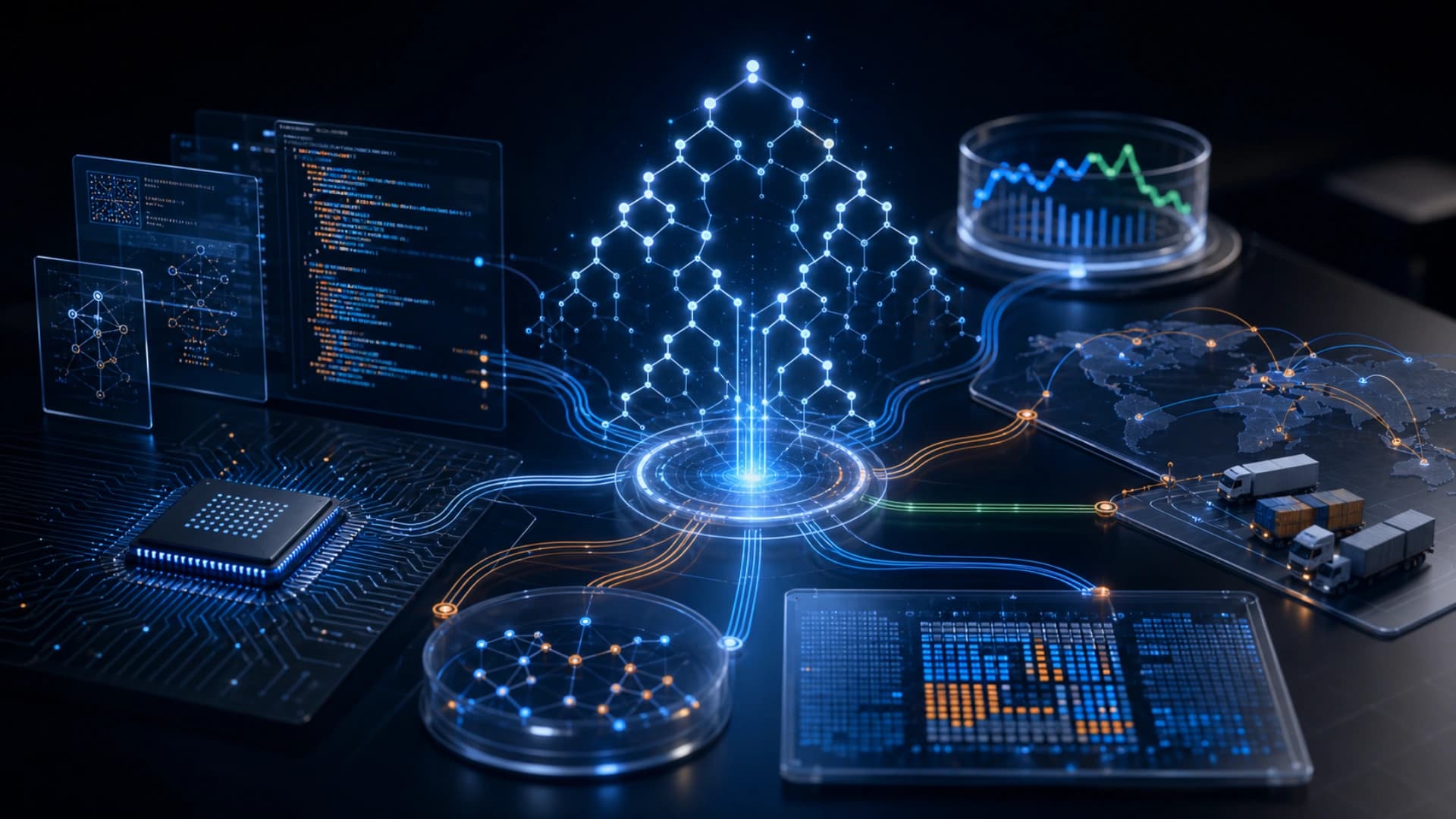
Google Cloud made AlphaEvolve generally available on July 10, 2026. It is not a normal coding assistant. It is a code optimization and discovery agent built on Gemini, designed to systematically explore large algorithmic search spaces and find better programs for business and research problems.
The positioning is clear. Many valuable problems are optimization problems: microchip design, delivery network planning, large-model training architecture, warehouse routing, forecasting pipelines, GPU kernels, and model efficiency in financial services. Traditional engineering can usually explore only a small part of the implementation space because the possible variants are too broad.
Google Cloud describes a four-step process. Define the problem with a seed algorithm, problem statement, and background knowledge. Measure candidates with a scoring function that captures correctness, performance, or operational constraints. Optimize by letting AlphaEvolve's agentic harness generate and evaluate candidate programs. Apply the resulting optimized algorithm directly to production workloads and infrastructure.
The important detail is that the evaluator comes first. AlphaEvolve is not asking a model to decide whether code looks good. It uses executable, measurable evaluators to test candidates repeatedly. That moves agentic code generation from producing plausible code toward searching for better code under explicit scoring rules.
The examples are broad. BASF used it for a supply-chain digital twin. Coolblue optimized a 28-day demand forecasting pipeline. FM Logistic improved warehouse routing by 10.4% on top of an already optimized baseline. JetBrains used it to explore IDE performance. Kinaxis reported gains in forecasting accuracy and runtime. Klarna doubled throughput in a large ML training pipeline while working under regulated financial-services constraints.
Google's own infrastructure examples are just as important. The post says AlphaEvolve has been used for next-generation TPU silicon design, Google Spanner compaction heuristics, compiler optimization, natural-disaster risk prediction, and quantum circuits for the Willow quantum processor. These examples show that AI agents are not only for app code. They can enter deeper engineering and scientific search problems.
For enterprises, the practical lesson is that agent workflows need to be tied to tests, benchmarks, and runtime constraints. Without a deterministic evaluator, it is difficult to move generated candidates into production. The future coding agent may be less like a pair programmer and more like a search system that repeatedly explores and verifies options inside rules defined by engineers.
This GA also makes the Gemini Enterprise Agent Platform direction more concrete. An agent can be a long-running search system: read the problem, generate candidates, run tests, submit scores, and continue exploring. When the bottleneck is supply chain, chip design, model training, logistics, or marketing prediction, this type of agent is much closer to business value than a general chat interface.