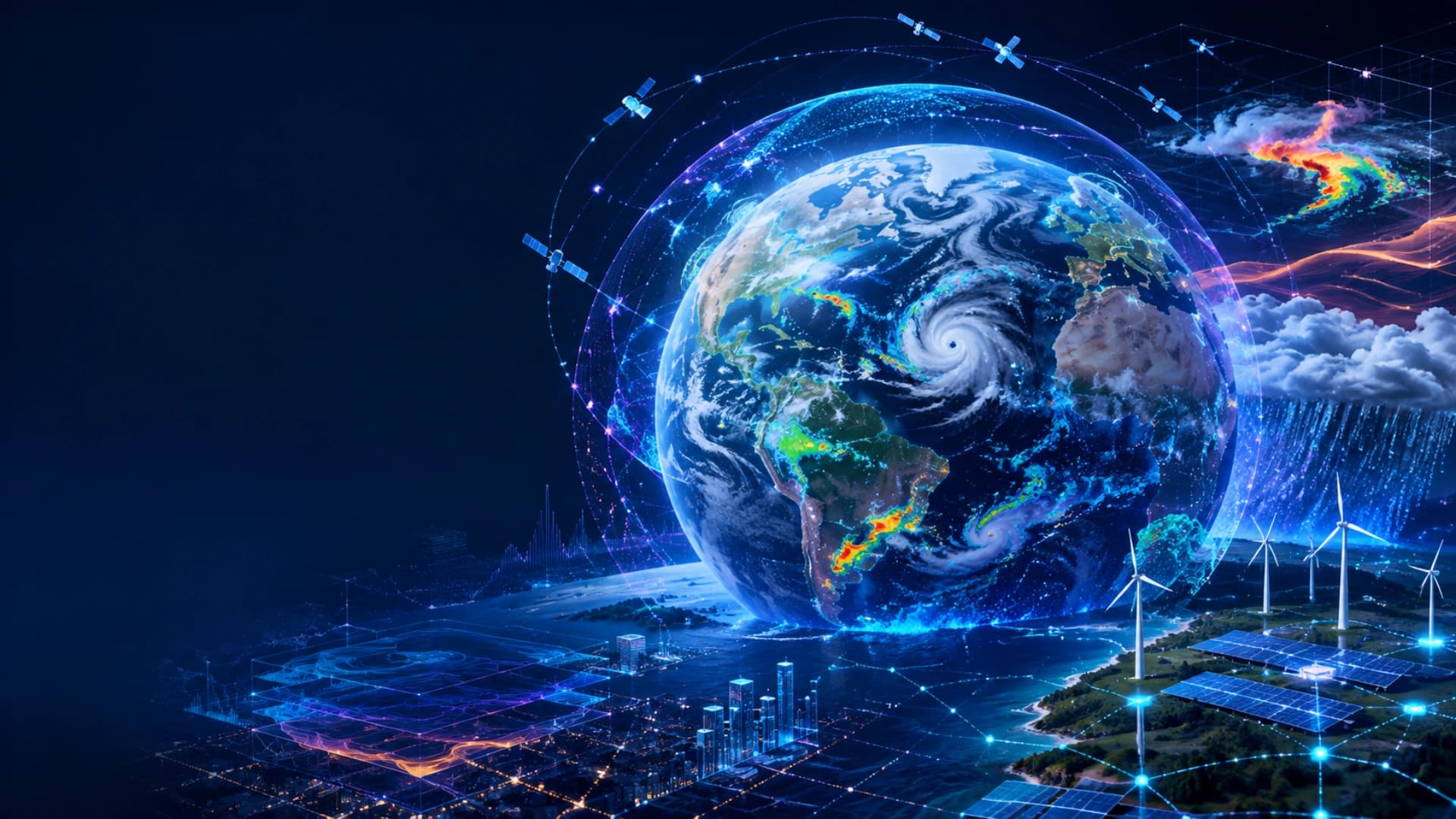
Google DeepMind and Google Research introduced WeatherNext 3 on September 3, 2026, moving its weather model from broad, relatively sparse forecasts toward a higher-frequency global data layer. The model ingests live geostationary satellite data, generates a new forecast every hour, and is being integrated into Google Search, Gemini, Google Maps, the Google Maps Platform Weather API, and Earth Engine.
The central change is not simply a larger model. It is a closer match between the observation cycle, the spatial detail, and what is happening on the ground. Google says WeatherNext 3 reaches 5-kilometer resolution for surface variables such as temperature and moisture, about 10 kilometers for other surface variables, and about 25 kilometers for atmospheric variables such as wind speed. WeatherNext 2 used a 25-kilometer grid with six-hour updates, so Google describes the new system as roughly five times sharper overall.
WeatherNext 3 also targets precipitation and clean energy. Google says it uses NASA GPM IMERG, satellite-radar reanalysis, and rain-gauge observations to improve rain and snow forecasts. In its evaluations, Google reports CRPS improvements of up to 60%, 30%, and 10% against different baselines, and says some product experiences can see up to 50% better precipitation accuracy for forecasts a day or more ahead. Those numbers need to be read by region, lead time, variable, and evaluation method rather than as a fixed improvement for every weather situation.
For energy and enterprise workflows, the output is broader than a general weather lookup. Google highlights 100-meter wind speeds, cloud cover, and solar radiation for wind and solar generation planning. More timely, detailed forecasts can also feed agriculture, supply chains, flight planning, emergency response, and outdoor operations. Weather AI is moving from answering whether it will rain to providing changing environmental variables for a daily decision.
Google is exposing the forecasts through BigQuery, Earth Engine, and Google Cloud Storage so researchers, developers, and businesses can query or download them without building the full model stack. That lowers the experimentation barrier, but it does not make the data a safe unattended decision source. Teams should preserve timestamps, forecast versions, geographic coverage, and observations so they can inspect drift after model updates.
The announcement also draws a necessary boundary: Google says official forecasts, severe-weather warnings, and public-safety advisories should come from local meteorological agencies or national weather services. Higher resolution and hourly refreshes can improve a workflow, but extreme weather involves risk communication, accountability, regional calibration, and human judgment. A model score cannot replace those controls.
The signal from WeatherNext 3 is that AI weather models are becoming data services and decision infrastructure rather than research demonstrations. The useful test is not a claim of global leadership. It is whether forecasts for a team's regions, seasons, precipitation patterns, and energy workloads arrive early enough and with enough provenance to support the next decision.