NVIDIA announced on July 20, 2026 that NVIDIA Agent Toolkit now includes Omniverse libraries. The libraries give AI agents tools for sensor simulation, GPU-accelerated physics, and simulation-ready asset validation inside existing 3D applications, with the aim of preparing physical AI training and testing environments.
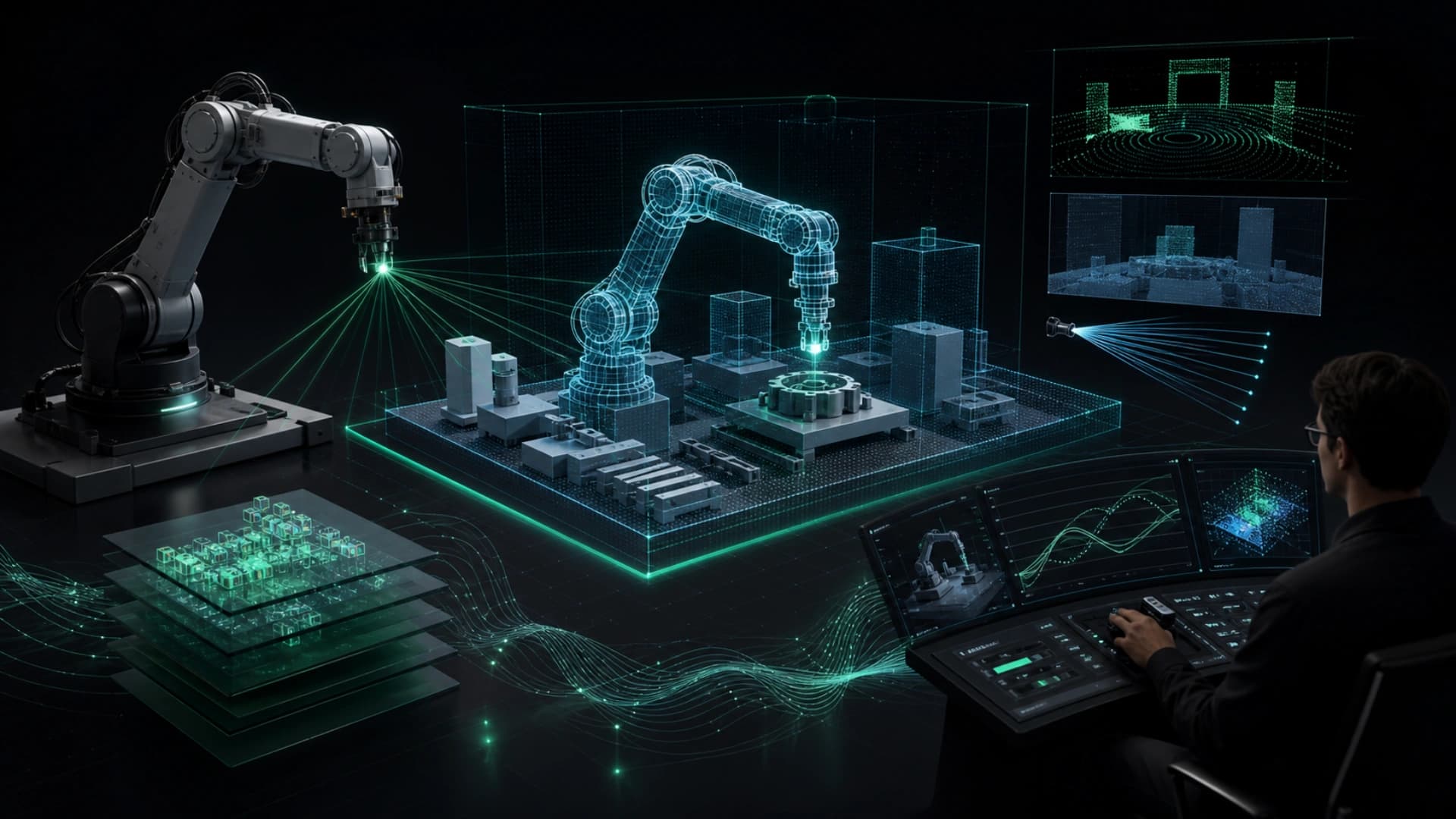
The focus is not another standalone chat agent. It is a set of domain capabilities that can be called inside an agent workflow. NVIDIA lists ovrtx for generating camera, lidar, radar, and related sensor outputs from 3D scenes; ovphysx for simulating behavior through properties such as collision, mass, friction, and motion; and CAD-to-SimReady skills for converting CAD data into OpenUSD-based SimReady assets.
That capability matters for robotics, industrial digital twins, and autonomous systems. Before a machine operates in the physical world, teams need to understand how objects collide, what sensors will perceive, and whether assets have the right scale and physical properties. If an agent can inspect scenes, flag issues, test changes, and prepare assets, the task is no longer just generating a 3D model. It is moving the model toward a state that can be simulated, validated, and revised.
NVIDIA says the new Omniverse libraries are available on GitHub, while SideFX and PTC are integrating related capabilities into 3D, CAD, and product-data workflows. The announcement also points to a Blender blueprint and support for cloud and local AI systems from NVIDIA RTX Spark to DGX Station. The examples suggest that agent-ready tools can add a capability layer to existing applications rather than requiring teams to abandon their current software.
The vendor announcement does not independently establish that generated scenes will be accurate or safe in the real world. NVIDIA’s technical material describes ovrtx as pre-release software, and gaps remain between sensor models, physical parameters, CAD conversion, simulation, and physical machines. Passing a simulation test does not remove the need for hardware-in-the-loop testing, expert review, fault injection, and staged deployment.
The more useful architectural idea is that an agent’s actions and its verification tools belong in the same system. A serious physical-AI workflow needs data and scene checks, tool permissions, simulation outputs, validation thresholds, versioned assets, human approval, and physical test results. It should not be measured only by how much content the agent can generate.
The update reflects a broader shift in agent development. The next competition is not only about which model answers best, but whether a model can call specialized tools safely and place its output inside a workflow with validation and clear accountability. For physical AI applications that connect design, engineering, and operations data, simulation-ready may be closer to a delivery standard than one-shot generation.