
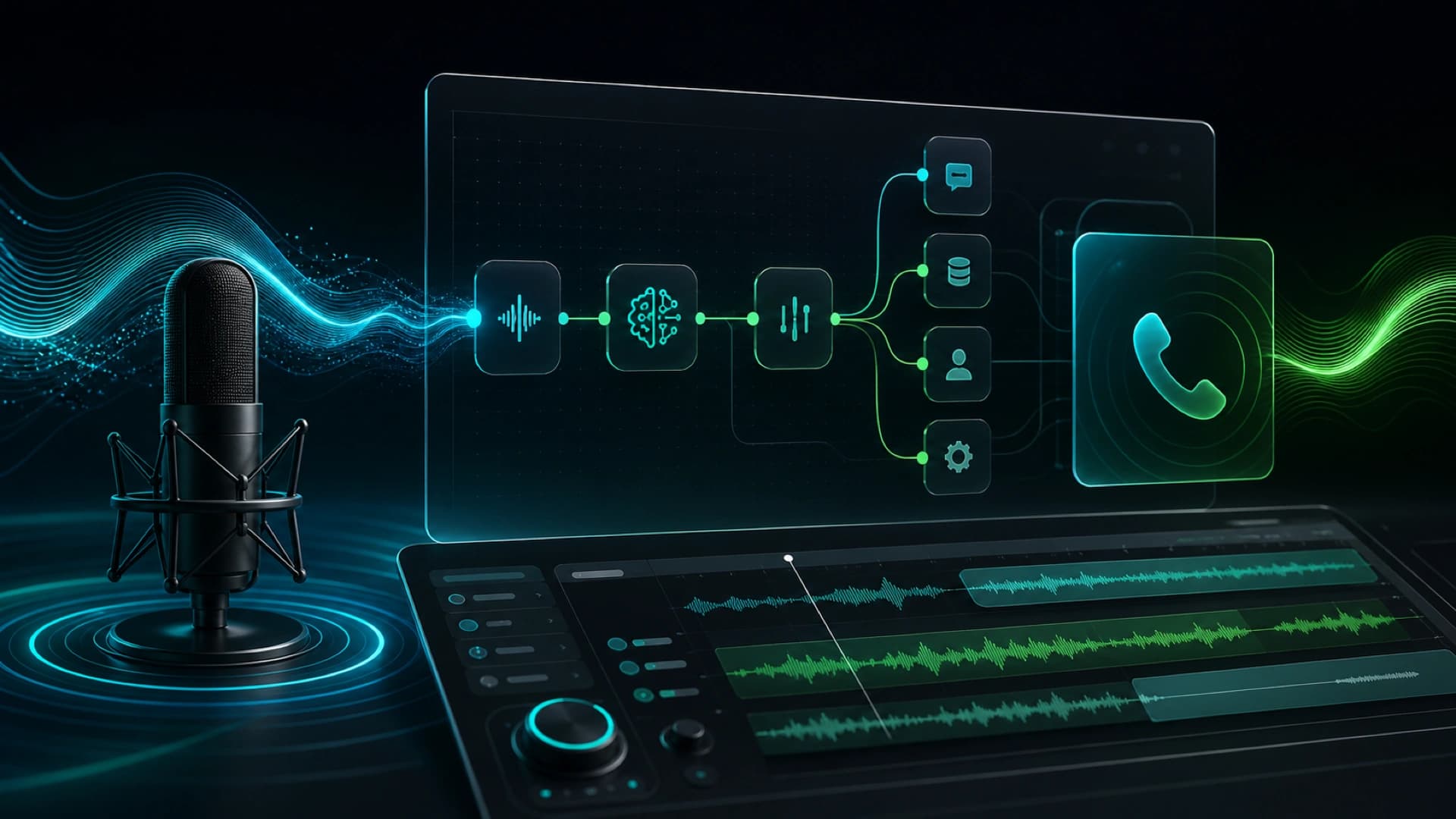
xAI announced Voice Agent Builder beta on July 1, 2026. It is aimed at operators and developers who want to configure production voice agents on Grok Voice without stitching together the surrounding stack. The product pitch is direct: create a personalized voice agent in about two minutes without writing code.
The product matters because voice AI agents have been expensive to engineer. A typical voice stack connects speech-to-text, a language model, and text-to-speech as separate services. Each handoff adds latency, cost, and another failure mode. xAI is instead putting the workflow inside a speech-to-speech interface tightly coupled to Grok Voice.
The feature set is broad. Voice Agent Builder includes telephony, knowledge retrieval, tools, guardrails, MCPs, and observability. Businesses can also bring existing phone numbers over SIP, connect tools to their own APIs and MCP servers, or connect a custom client over WebSocket. That points beyond a demo voice bot and toward actual operating workflows.
Voice agents are hard because real calls are messy. xAI highlights low-quality telephony audio, background noise, accents, interruptions, callers changing their minds, and ambiguous workflows across more than 25 languages. Those are not typical text-agent problems, but they are everyday conditions in support, sales, booking, and internal helpdesk calls.
Review and guardrails are also important. Calls are recorded and transcribed, teams can inspect tool usage, and guardrails can stop behavior such as reading card numbers or going off script. Those controls decide whether voice agents can move from experiments into production, because voice mistakes usually carry higher cost than text mistakes.
The pricing signal is also clear. xAI prices agents at the API audio rate and lists $0.05 per minute of audio, with telephony on a free provisioned number billed separately. For businesses, that makes voice AI easier to estimate against call volume instead of reconciling three or four vendor pricing tables.
Voice Agent Builder shows the next surface for AI workflows. The market is not only chat, coding, or documents. It is moving into calls, customer support, sales, and appointments. Once a voice agent has a knowledge base, tools, guardrails, phone numbers, and observability, voice automation becomes an operating workflow rather than just a speech model.