On September 15, 2026, Google published new AI & Economy ATLAS data and an open interactive experience for comparing AI use across countries and occupations. A related study from Google, Google DeepMind, and MIT FutureTech looks at how scientists use AI and where work begins to slow down after productivity improves.
Google says ATLAS data shows AI use in India’s creative industry at a relatively high level: arts, design, and media occupations account for 19% of work-related AI usage, or 1.6 times the global average. In the United States, computer and mathematical occupations account for 30% of work-related AI usage, twice the share in the rest of the world. These are analyses of ATLAS data, not a universal census of every occupation or country.
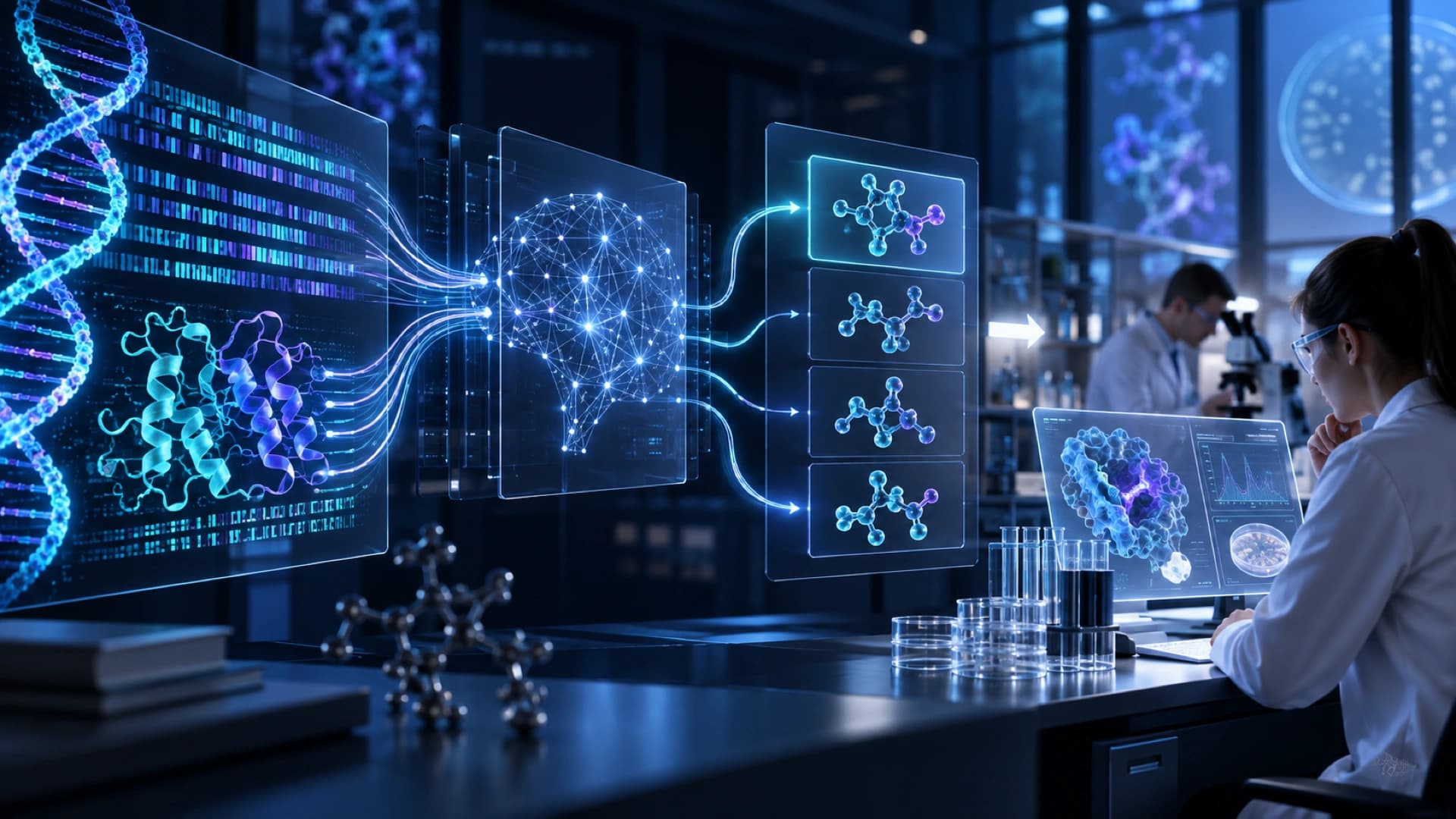
The science findings are more specific. Nearly half of surveyed scientists report using some form of AI every day, with LLMs and specialized models serving different roles. The study analyzes 2,600 specialized AI models and surveys more than 600 scientists in the U.S. and U.K., organized with a MIT FutureTech taxonomy of scientific work. LLMs such as Gemini appear across many fields and task categories, while specialized models are relatively more common in health and life sciences and domain-specific prediction, generation, and simulation.
Scientists report saving just under seven hours a week with AI, potentially freeing time for research. Google also reports that the time gain does not automatically become more discovery. Researchers spend significant time validating AI outputs, the backlog of hypotheses grows, and physical experimentation and clinical validation become more visible bottlenecks. AI can accelerate search, organization, and first-pass hypothesis generation without creating laboratory capacity at the same speed.
ATLAS also shows geographic and occupational differences. In OECD countries, computer and mathematical work and business and financial operations lead usage; outside the OECD, office and administrative support, arts and media, and education-related work are among the leading categories. Google says Brazil and the UAE have higher adoption than income alone would predict, while real-time equipment diagnostics and troubleshooting account for 7% of work-related AI use in Brazil and Germany compared with 4% in Japan.
The important signal is not that AI immediately eliminates a profession. It is that the constraint in a workflow can move. When search, summarization, code, data preparation, and initial hypotheses become faster, the next limits may be review time, experimental access, approval responsibility, and the feedback loop back into the model. Adding more AI accounts does not necessarily clear the queue downstream.
For businesses and research organizations, a more useful measurement system follows the whole process: time saved, candidates produced, human validation time, candidates that advance, and how errors are found. That is closer to operational value than prompt volume or active-user counts, and it exposes the review and quality costs that AI adoption can add.
ATLAS is analysis from Google and its research partners, so it does not by itself establish a causal improvement in every scientific output. A reasonable conclusion is narrower: AI is expanding the searchable and processable space, while durable gains require investment in validation, experiments, data quality, and cross-disciplinary collaboration. As models get faster, the redesign challenge often shifts to the entire research production line.