
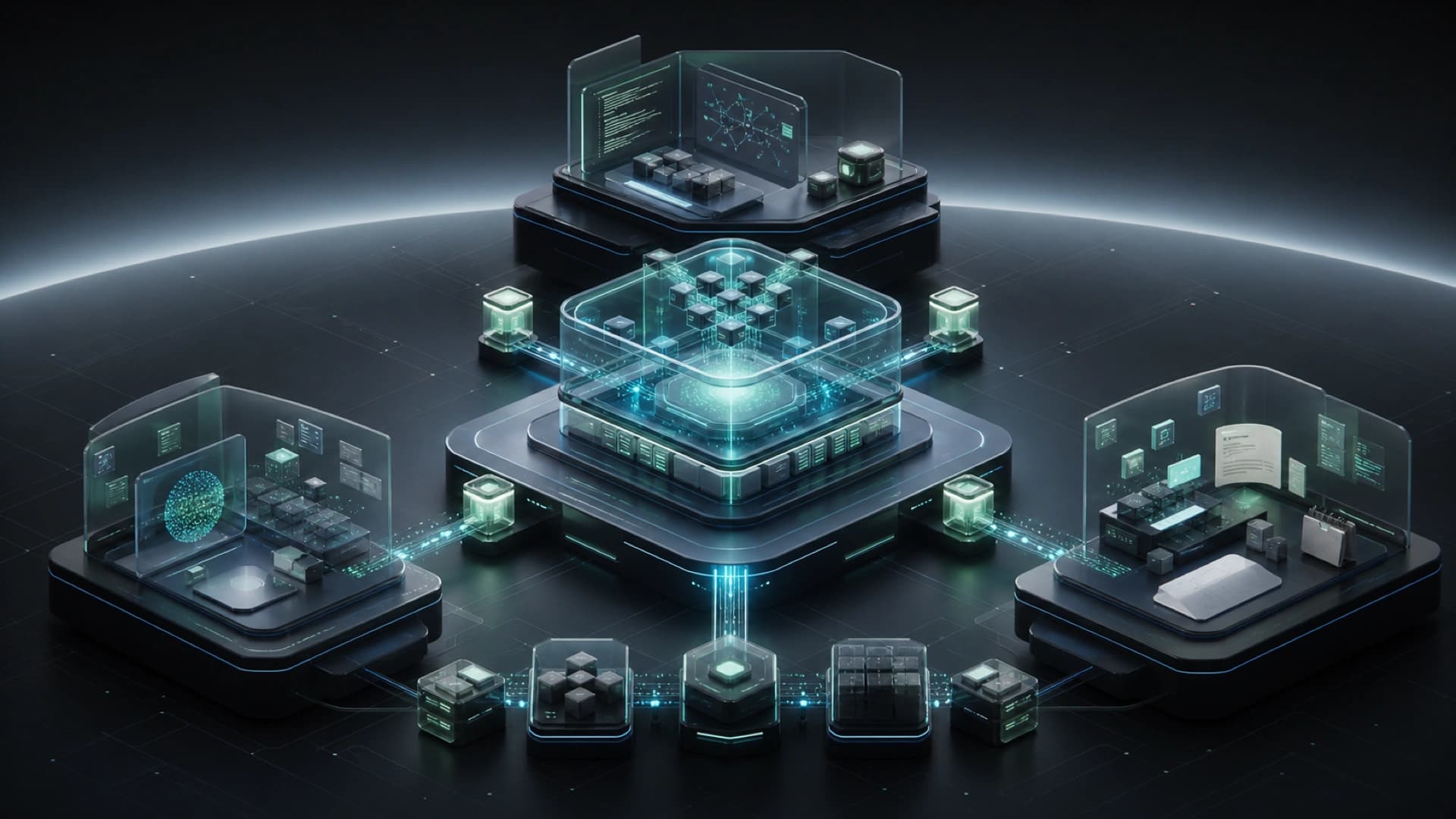
On August 3, 2026, Microsoft Research released Orchard, an open framework for scalable agentic AI research. The important idea is not another orchestration layer. It is to pull the environment, sandbox, training data, and evaluation workflow out into a reusable foundation that can serve multiple tasks.
Orchard is built around Orchard Env, a lightweight Kubernetes-based environment service for sandbox lifecycle management, command execution, file I/O, network policy, a REST API, and agent integration. It supports software engineering, web navigation, and personal-assistant tasks without requiring a separate execution stack for each type of agent.
That design addresses a common evaluation gap: the simplified agent loop used in research is not always the same as the harness used in deployment. Orchard records model calls through a lightweight proxy and runs each rollout in its own container, allowing agents to train and evaluate directly inside Codex, OpenClaw, ZeroClaw, or another real harness. The goal is to reduce the gap between doing well in a simplified environment and failing when the real toolchain is introduced.
Microsoft Research is also releasing three training recipes—Orchard-SWE, Orchard-GUI, and Orchard-Claw—alongside training data and evaluation methods. Orchard-SWE targets coding agents, Orchard-GUI targets browser interaction, and Orchard-Claw targets personal-assistant work such as email, calendars, search, and coordination across tools. A shared environment layer lets researchers extend the same sandbox and data pipeline across domains.
The reported results include Orchard-SWE moving from a 61.4% baseline to 69.7% on SWE-bench Verified, reaching 73% with value-model reranking; Orchard-GUI reaching a 68.4% average across WebVoyager, Online-Mind2Web, and DeepShop; and Orchard-Claw completing 59.6% of Claw-Eval tasks with up to three attempts, rising to 73.9% with ZeroClaw. These are publisher-reported results under specified models, harnesses, data, and evaluation settings, not guarantees for every deployment.
Orchard’s most useful architectural signal is the separation of agent capability from agent execution environment. The model, harness, task, and evaluator can change while the underlying sandbox, data collection, and control interfaces remain reusable. For researchers, that makes experiments easier to reproduce. For engineering teams, it is a reminder that long-running agent evaluation must include permissions, failure recovery, network boundaries, and consistent observability—not only model scores.
This is still a research and open-source framework release, not a turnkey production service. Teams need to evaluate Kubernetes operations, isolation, data sources, model licensing, and whether the benchmarks match their own work. Orchard points to a broader shift in agent infrastructure: the important layer is becoming reusable, observable environments that can be validated across harnesses, not just a single model’s capability.