
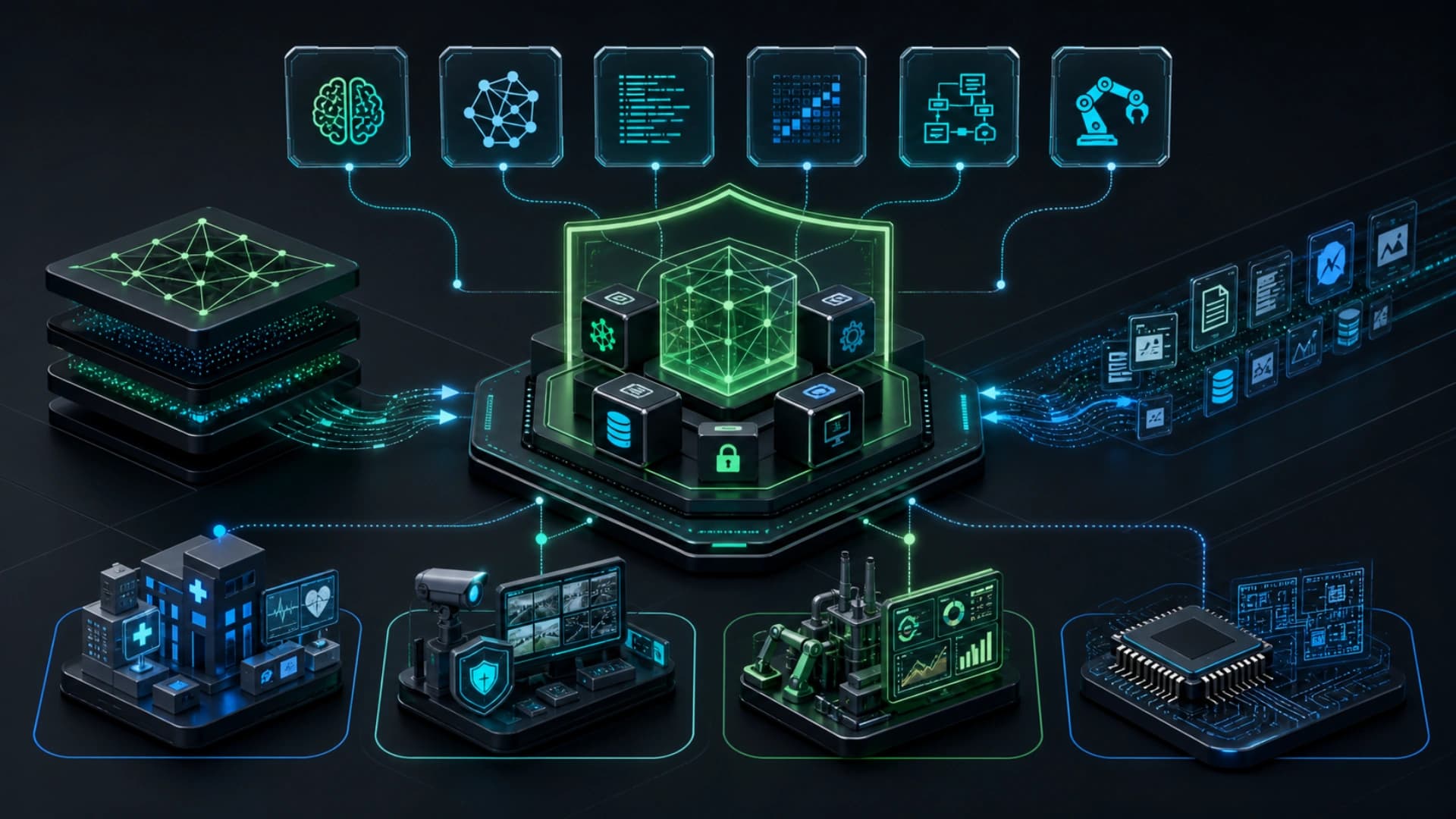
NVIDIA introduced its Agent Toolkit on June 23, 2026 in a post about how businesses are building specialized AI they can trust. The toolkit combines models, tools, skills, and a secure runtime. The goal is to help enterprises and developers build digital AI coworkers that are safer, faster, lower-cost, customizable, specialized, controllable, and trustworthy.
The important shift is that agents are moving from general assistants toward enterprise work systems. Many companies have already tried using general chatbots to write content or answer questions. Real deployment is harder because businesses run into data permissions, tool connections, execution environments, cost controls, auditability, and missing domain knowledge. NVIDIA's argument is that enterprises need an agent stack that can be customized around actual workflows.
The Agent Toolkit separates agent capability into layers. Models provide reasoning, tools let an agent act, skills package task-specific knowledge, and the secure runtime handles execution, controls, and trust boundaries. That structure fits enterprise needs because different departments cannot solve every workflow with the same prompt.
NVIDIA places specialized agents in several industry contexts, including healthcare, cybersecurity, operations, and chip design. Those environments share the same pattern: specialized data, strict process, high cost of error, and a need for explainability and auditability. For agents to enter those workflows, they must connect to the right tools while operating inside clear runtime and policy constraints.
Another key point is the open and modular approach. Enterprises do not necessarily want to be locked into one closed agent platform, especially when models, tools, and data may span cloud, on-prem systems, private databases, and industry platforms. A modular toolkit lets teams swap models, add internal tools, define skills, and tune architecture around cost, latency, security, and governance.
The release also shows that the agent market is maturing. Early attention focused on whether a model could answer well. The next comparison is whether an agent can safely finish work in a real environment. Runtime governance, tool limits, action tracing, output review, and enterprise-data integration will matter more than one-off response quality. NVIDIA is packaging those pieces around the production adoption problem.
For enterprises, the practical takeaway is not to buy one generic agent and expect it to understand every workflow. A better approach is to choose one high-value domain, define the data, tools, skills, approvals, and monitoring, then place an agent inside that boundary. Specialized agents are not mainly about replacing everyone. They are about turning repeatable, cross-system, reviewable work into controllable digital coworkers.