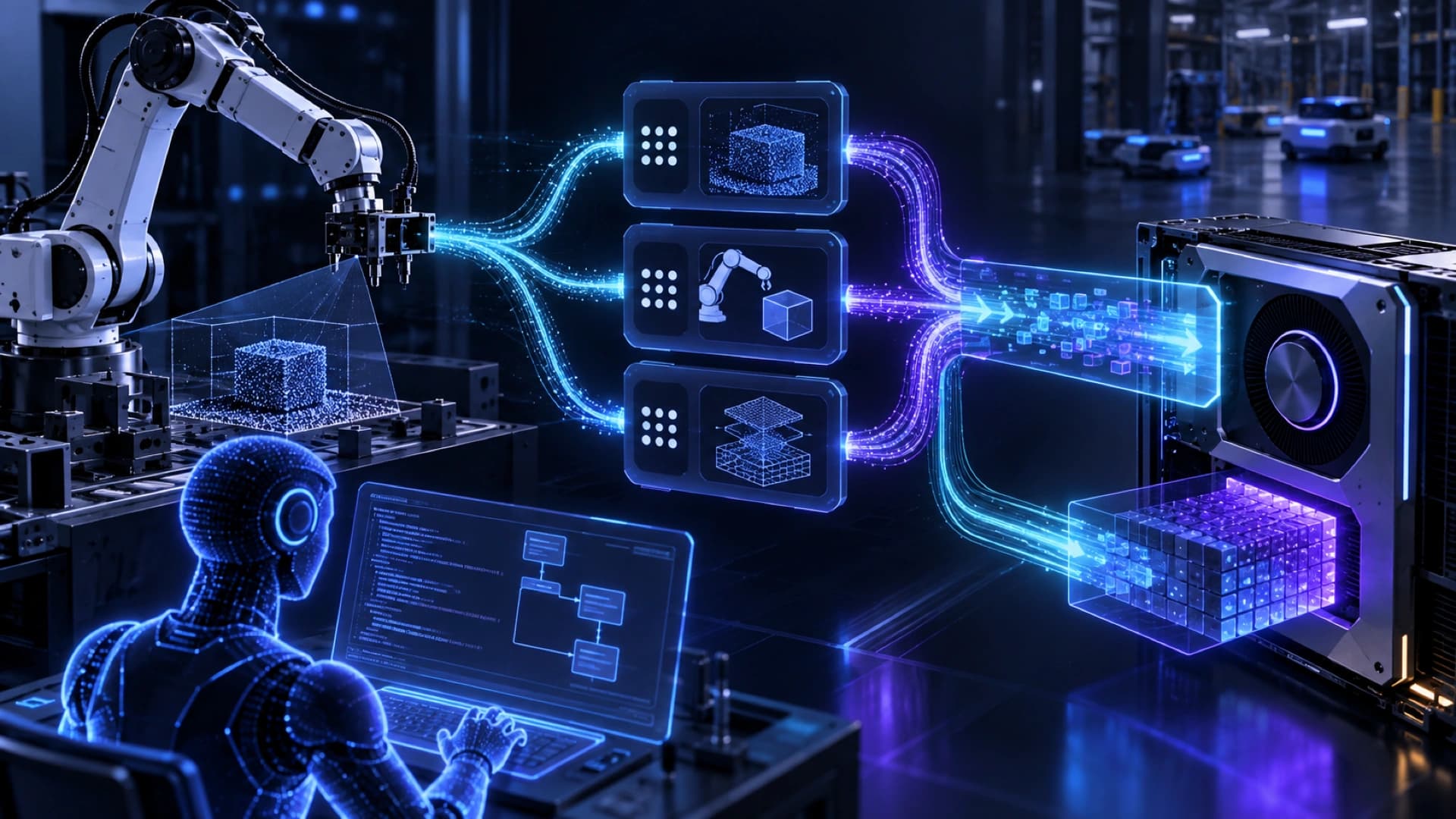
NVIDIA published an example on September 22, 2026, of using an AI agent to migrate a ROS 2 node. The aim was not to redesign the robot, but to find where CPU serialization and copies still slowed a GPU-accelerated pipeline. The example uses rosidl::Buffer, NVIDIA’s CUDA buffer backend, and Isaac ROS 5.0.
In ROS 2 Lyrical, variable-length primitive array fields can be represented with rosidl::Buffer. When runtime requirements are met, the CUDA buffer backend lets nodes exchange GPU-resident payloads while keeping standard ROS messages and node boundaries. If neighboring nodes cannot use the CUDA backend, the system can fall back to the CPU path.
NVIDIA demonstrates the flow with a Depth Anything 3 TensorRT ROS 2 node. The coding agent uses a migrate-node-to-rosidl-buffer skill to audit allocations, serialization, stream ownership, and fallback behavior before proposing a minimal interface-preserving patch. The changes add dependencies, a subscription option, CUDA allocation, and handle extraction rather than creating custom messages or separate CPU/CUDA topics.
Verification goes beyond a successful build. NVIDIA recommends using Nsight Systems to check for payload-sized host-device transfers at the ROS boundary and checking that msg->data.get_backend_type() reports cuda when both endpoints meet the requirements. This separates the agent’s code changes from runtime backend negotiation, buffer lifetime, and actual data movement.
The example shows a useful role for an AI coding agent in specialized migrations: trace the data path, propose the smallest change, preserve existing interfaces, and help assemble a verification plan. Safety and performance still depend on build, runtime, profiling, fallback, and hardware conditions; a plausible patch does not generalize to every ROS graph.
NVIDIA’s post is a technical demonstration and tutorial, not a cross-platform benchmark. Zero-copy transport depends on the ROS 2 distribution, RMW implementation, backend, node placement, and data types. Before deployment on Jetson AGX Thor or another robot, teams still need hardware-specific latency, memory, failure-fallback, and human-safety testing.