
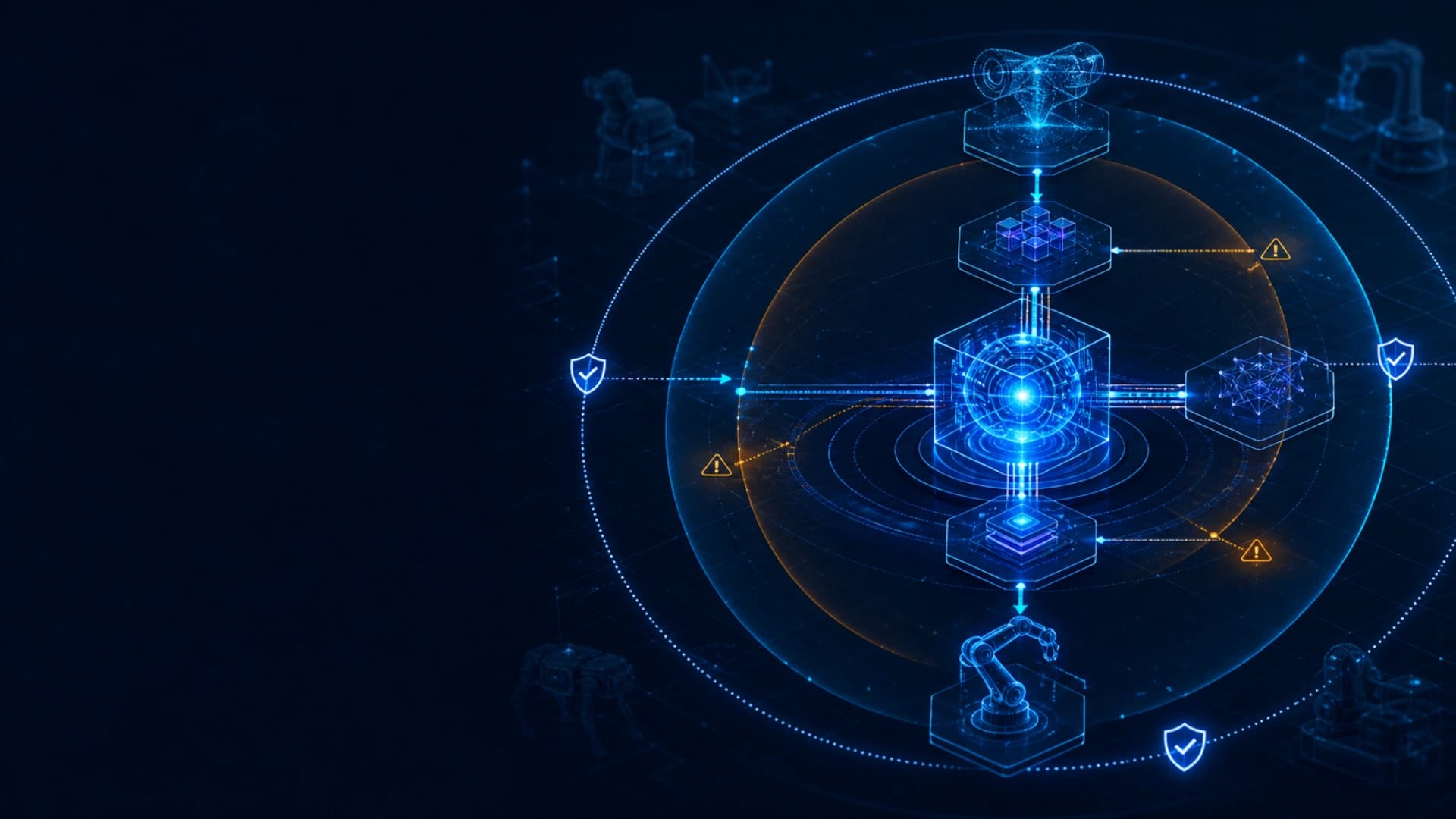
An arXiv study uploaded on August 17, 2026, reframes the security of foundation-model-powered embodied agents around trust boundaries. The authors argue that when a model participates in perception, reasoning, planning, and action generation, risk does not stop at text output. A digital input can propagate through the loop into physical behavior, so robots, VLAs, and tool-using embodied agents need a broader security model than text-only chatbots.
The paper introduces a first-compromised-trust-boundary principle that separates an attack surface from an attack mechanism. The first asks where an attacker initially changes a system representation. The second describes whether the method is prompt injection, a backdoor, poisoning, or an adversarial example. The distinction makes it possible to trace a propagation path from input and state into planning and action instead of treating an attack label as the location of risk.
The authors organize the system into five layers and twelve surfaces, covering the model supply chain, user instructions, context and memory, the physical semantic environment, multimodal perception, world state, reasoning, task planning, action interfaces, middleware, multiagent communication, and execution control. For deployment teams, this map is more useful than a single LLM firewall checklist because each boundary needs different controls and evidence.
The survey corpus contains 58 attack records and 61 defense records through August 15, 2026. The authors report that attack research is concentrated on multimodal perception and action interfaces, while defenses are concentrated on action-level and runtime protection. Context and long-term memory, middleware and networking, world-state integrity, and multiagent trust receive comparatively less attention. These are observations from the paper's literature corpus, not incident rates for every embodied system.
Embodied agents differ from text agents in a fundamental way. Model output can pass through code, APIs, skill libraries, motion planners, and controllers before becoming an action with temporal accumulation. A small error can change the next observation and grow over a long task, while defenses must operate under tight latency budgets. Checking whether a model refused a malicious sentence is therefore not enough to establish that the final action or environment state is safe.
For engineering teams, a safer evaluation pattern is to record perception, state updates, plans, tool calls, and actions as traceable events, then put independent policy gates, simulation, and human confirmation around high-impact actions. Multi-robot systems also need identity, message authentication, least privilege, shared-memory isolation, and claim provenance. The paper discusses security architecture and evaluation; it does not provide operational attack instructions.
The practical takeaway is to move security evaluation from what the model said to which trust boundary changed first and how the error crossed the closed loop. Any agent that reads external data, keeps long-term memory, or calls physical tools should include context, middleware, world state, and collaborator trust in its threat model rather than adding a review only before the final action.