
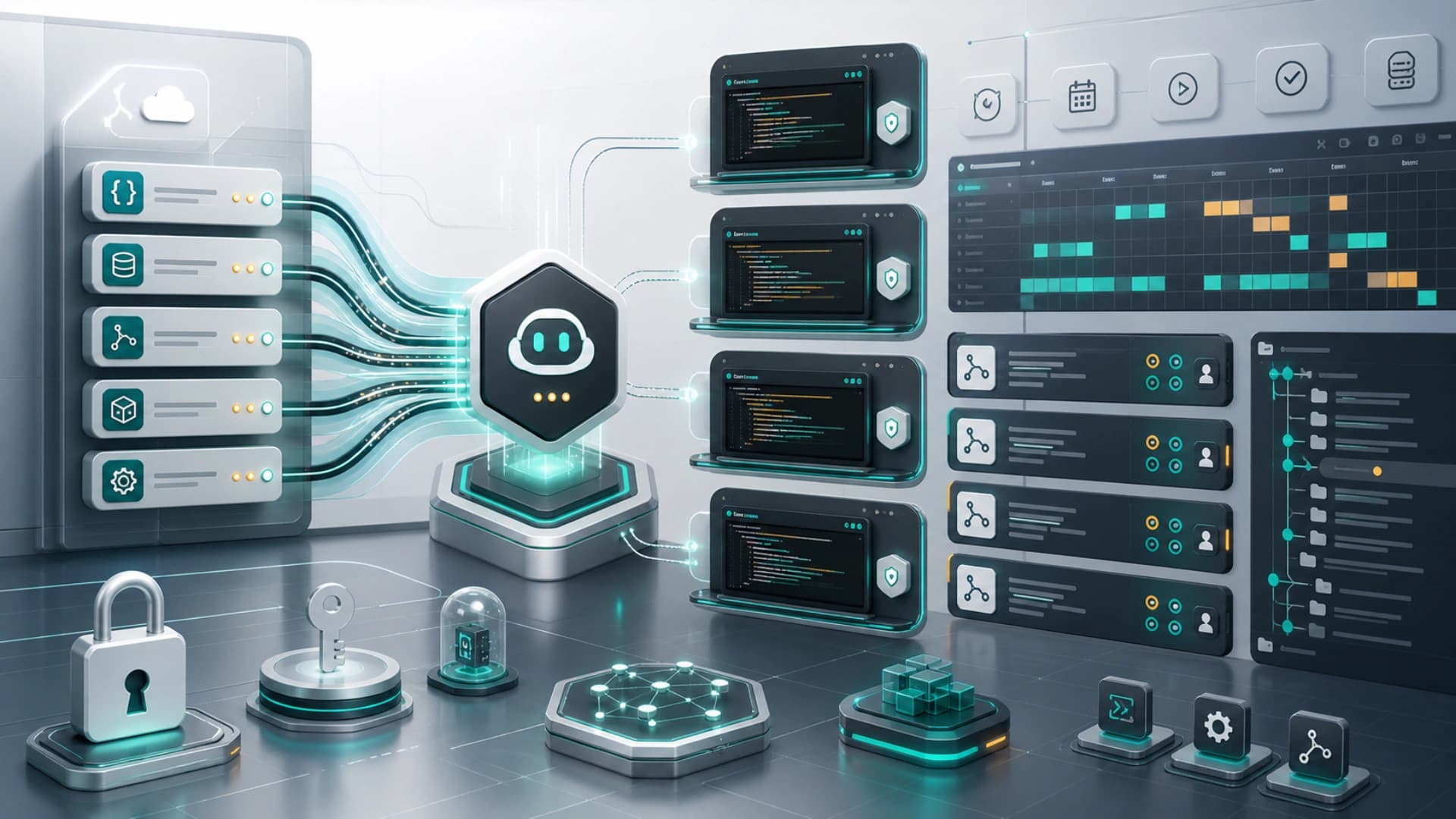
GitHub's Agent tasks REST API looks like a small API preview, but it is a meaningful developer-workflow signal. Copilot cloud agent has mostly been triggered from product surfaces. With the new public preview, Copilot Pro, Pro+, and Max users can programmatically start and track agent tasks through REST API calls.
Copilot cloud agent works in the background inside its own development environment, where it can make and validate code changes, then open a pull request. The API turns that capability into something custom automations can call. Once an agent task can be triggered from a script, internal developer portal, or release pipeline, the coding agent starts looking like platform infrastructure.
GitHub's examples are concrete. Teams can fan out refactors or migrations across many repositories from a simple script. They can create new repositories from an internal developer portal. They can automatically prepare a weekly release, including release notes. These are not single code-completion tasks. They are cross-repository, cross-time, cross-workflow engineering operations.
Progress tracking is just as important as task creation. Once work leaves a live chat session, teams need to know whether it has started, where it is blocked, what changes were produced, and whether a pull request exists. Agent observability becomes part of the product surface, not an optional extra.
The authentication model also matters. GitHub says the API supports classic personal access tokens, fine-grained personal access tokens, and OAuth tokens. That makes integration into developer tooling easier, but it also raises the bar for permission scope, token rotation, audit logs, and repository boundaries.
The launch fits into a broader GitHub Copilot week. Copilot CLI gained scheduling and a rubber duck review agent. The Copilot app technical preview expanded. Copilot cloud agent gained Gemini model support. Now agent tasks can be scheduled and tracked through REST API. Together, those moves show coding agents shifting from interaction tools into orchestratable engineering resources.
For software teams, the next step is not to hand every vague feature request to an agent. It is to identify repeatable, testable, low-risk workflows that benefit from API orchestration: dependency updates, documentation sync, release checklist preparation, schema migration prep, or mechanical refactors across multiple repositories.
The core signal is that coding agents are entering CI/CD, internal developer platforms, and engineering governance. When an agent can be triggered by API, tracked for progress, and absorbed into pull-request review, the hard questions become task boundaries, review gates, and recovery paths.