
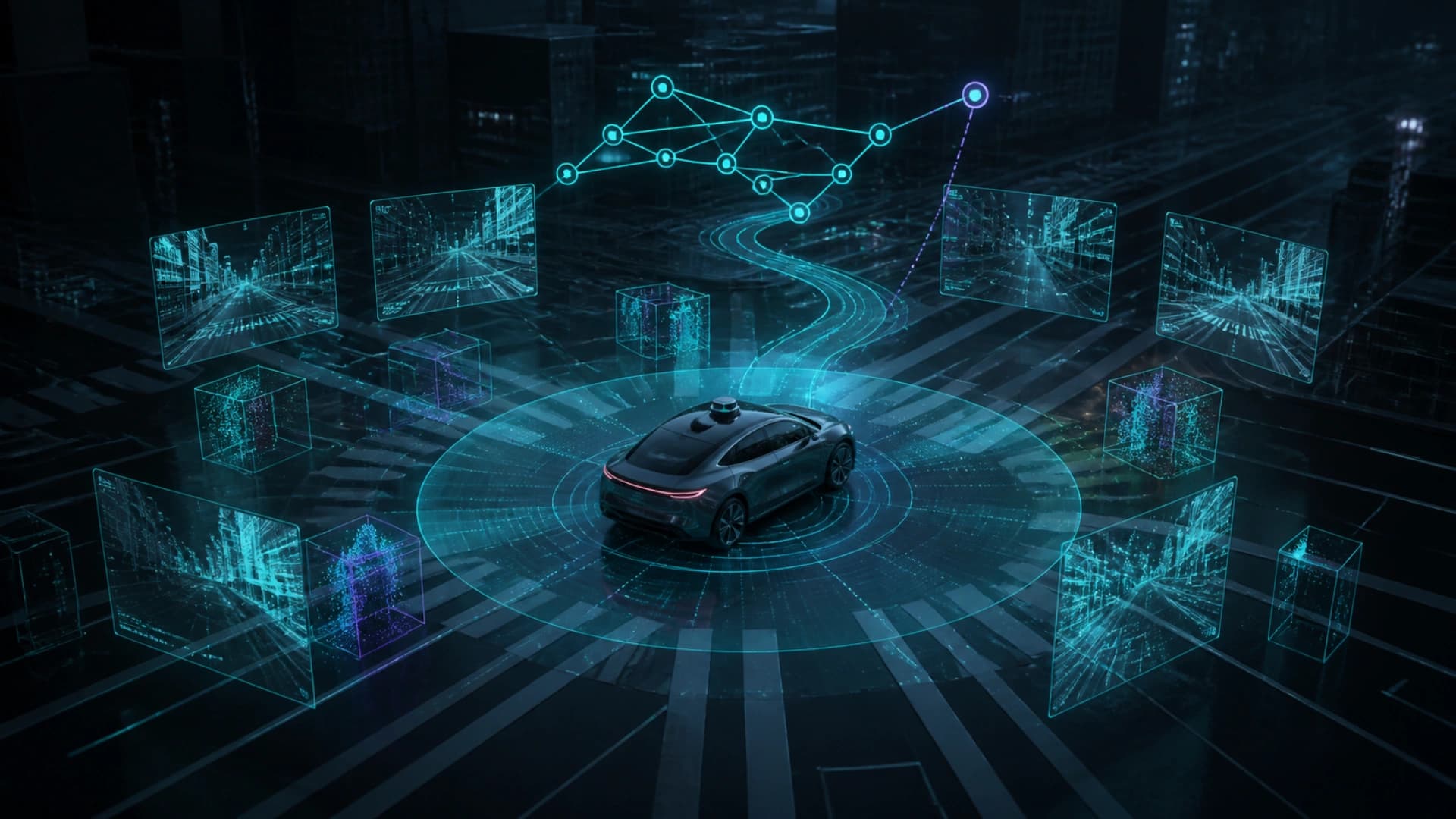
On August 4, 2026, NVIDIA announced that Alpamayo 2 Super is available for commercial use. The model targets robotaxis and other autonomous vehicles. Its focus is not only detecting road objects, but understanding rare and difficult long-tail situations, reasoning about cause and effect, choosing an action, and producing a path that a vehicle can execute.
Commercial openness is the main change in this release. NVIDIA says Alpamayo 2 Super is available on Hugging Face under the Linux Foundation’s OpenMDW-1.1 license, which covers fine-tuning, derivative models, and commercial redistribution. Automakers, fleet operators, and suppliers can adapt the model to their own data and driving policies without seeking separate deployment permissions.
The model is built on NVIDIA Cosmos 3 Super Reasoner and post-trained with reinforcement learning. NVIDIA describes a cloud-to-car workflow: use a larger model in the cloud to produce reasoning traces, synthetic training data, and teacher outputs, then distill specialized models for efficient real-time inference inside vehicles. The split separates development-time reasoning capacity from the latency, cost, and compute constraints of an onboard system.
For each driving situation, Alpamayo 2 Super can produce five connected outputs: a planned trajectory, a chain-of-causation trace for the decision, a meta-action that represents intent, reasoning auto-labels for training and validation, and visual question answering with 2D visual grounding. NVIDIA presents these outputs as a way for developers to connect what the model saw with the action it selected and the data used to validate it.
NVIDIA also published its own benchmark results. Alpamayo 2 Super ranked first on LingoQA among nearly 40 evaluated models using NVIDIA’s Lingo-Judge metric. NVIDIA reports margins of 17.0 points over Qwen2.5-VL 72B, 15.1 over Gemini 2.5 Pro, and 23.2 over GPT-4o. These are publisher-reported results under specified models, data, and evaluation methods, not independent guarantees across fleets, hardware, or road conditions.
The model is also positioned as an autolabeler for fleet data, generating causal traces and 2D-grounded answers, while supporting scene understanding, model critique, and knowledge distillation. NVIDIA lists AlpaSim closed-loop simulation, AlpaGym reinforcement learning, Physical AI datasets, and Halos safety validation as parts of the wider development stack.
An open commercial license lowers an adoption barrier, but it does not make a model road-ready by itself. Fleets still need to validate sensor fusion, latency, extreme weather, responsibility, regulation, and safety cases. Inspectable outputs should not be read as proof that the model is safe in every situation. The larger signal is that physical AI is bringing open weights, traceable data, and deployment workflows into one product strategy.