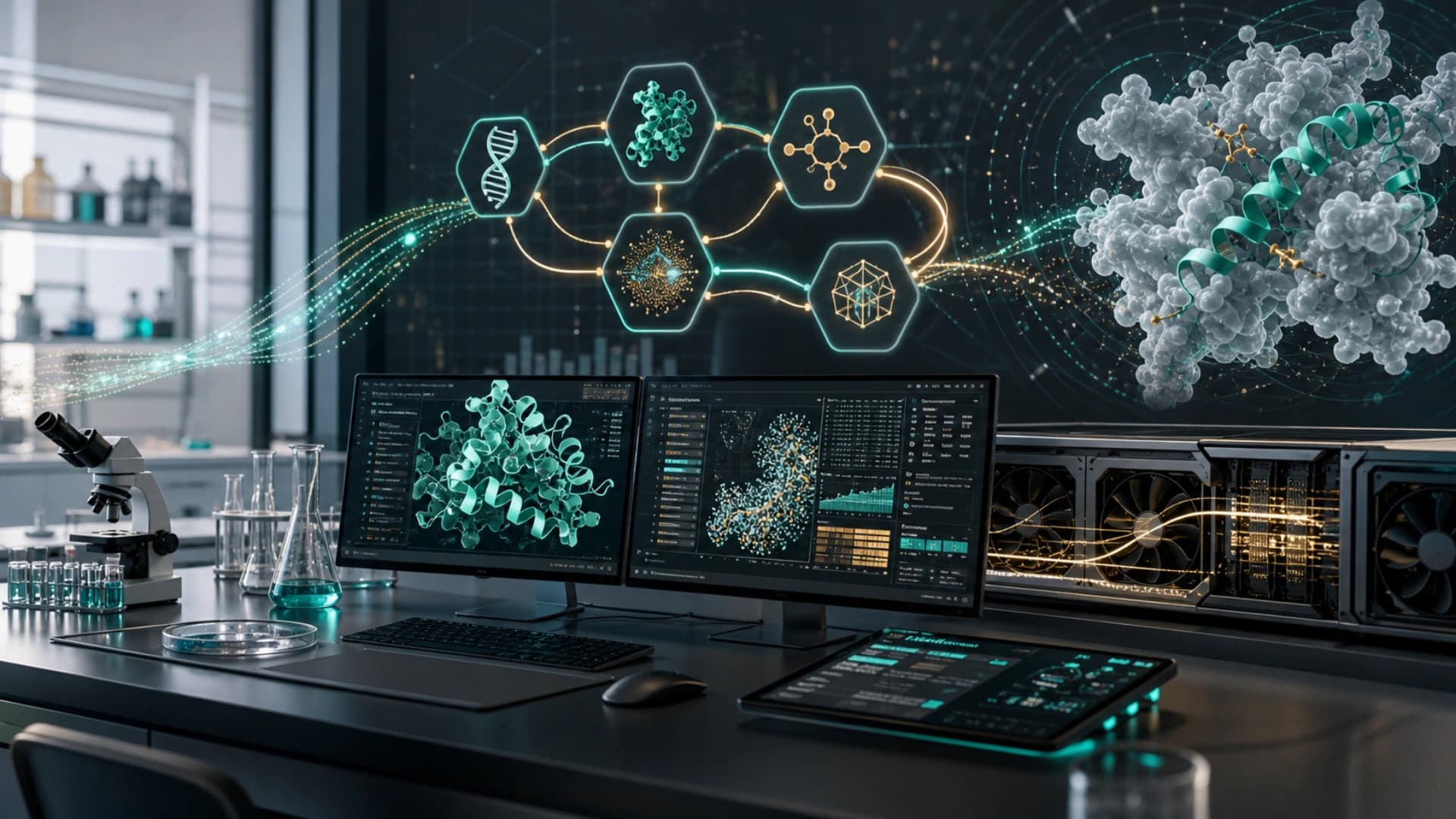
NVIDIA described on June 30, 2026 how BioNeMo Agent Toolkit can work with Claude Science. The update is aimed at life-science research, where teams need to connect accelerated AI tools, model services, and agent workflows to the environment where scientists already work.
Life sciences are a natural domain for AI agents because research workflows often cross literature, sequence data, molecular structures, simulation, screening, and validation. A single chat model cannot cover every step by itself. An agent toolkit can turn specialized tools into callable capabilities, allowing researchers to describe a task in natural language while the system connects to models and compute resources behind the scenes.
BioNeMo's role is to productize AI capabilities for biomolecular and drug-discovery work. When those capabilities become available through an agent workflow in Claude Science, researchers move beyond asking a model to explain a concept. They can get closer to arranging an analysis process: select data, call a model, compare results, generate a summary, and decide the next experiment or computation.
The same direction reflects a broader enterprise AI trend. Vertical agents will not be built on general models alone. They need specialist tools, traceable data sources, compute infrastructure, permission controls, and human approval. In life sciences, the cost of a wrong result is high, so the agent should support research workflows rather than replace scientific judgment.
For the AI workflow market, the NVIDIA and Anthropic combination is a useful pattern. Model companies provide reasoning and interaction, infrastructure companies provide accelerated compute and domain tools, and agent workflows connect both to the place where users actually work.