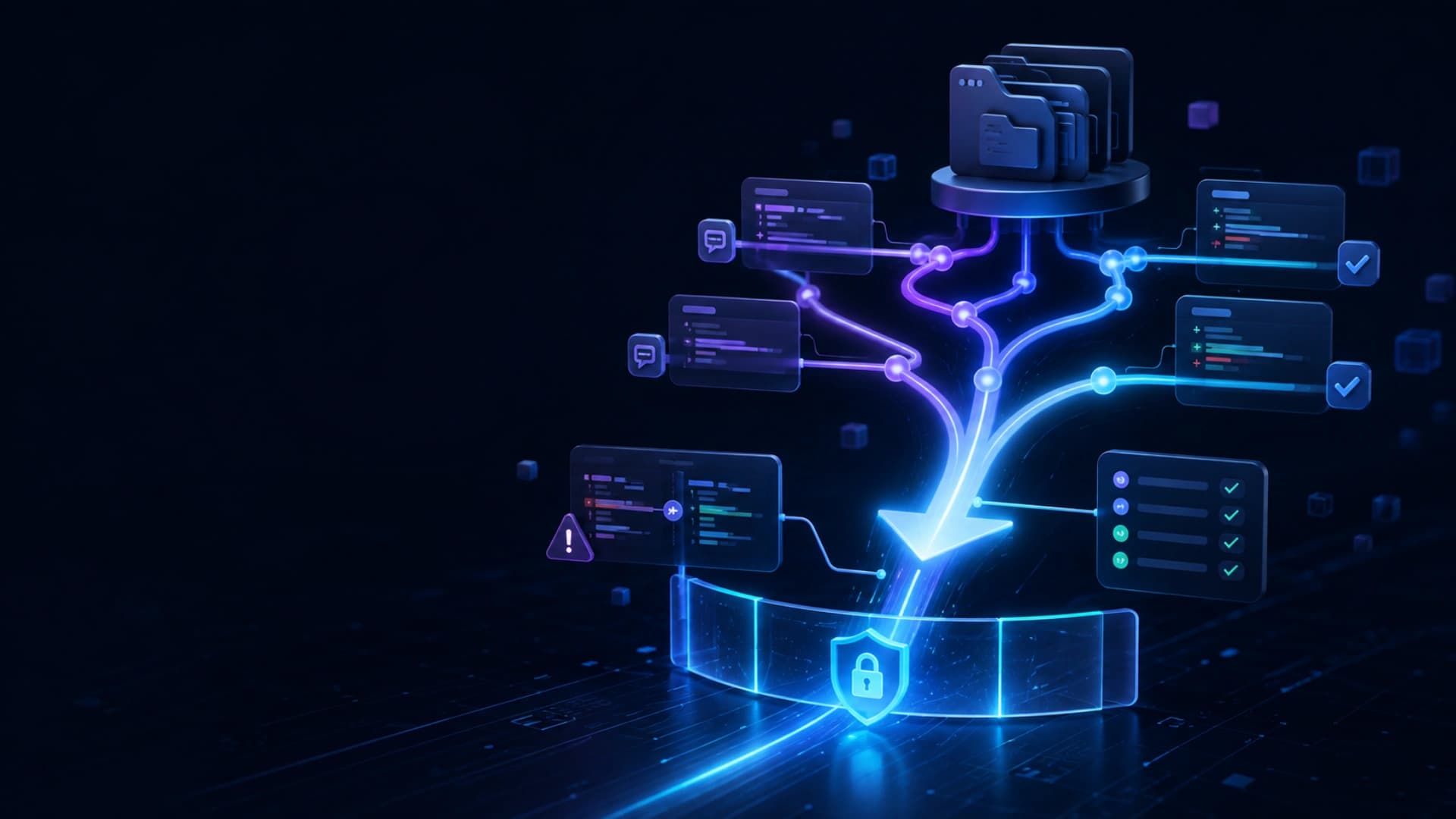

In a July 17, 2026 post, NVIDIA describes post-training for agentic AI as a continuously running loop rather than a one-time finishing step after pretraining. Agents operate across changing codebases, policies, tools, and production environments, so new edge cases keep returning to the process that improves the model.
NVIDIA contrasts agentic AI with ordinary question answering. An agent receives a goal, plans steps, uses tools, and handles failures along the way. Post-training therefore needs many rollout environments where the model attempts a task, receives a reward, and updates its weights. The compute footprint grows not only because individual runs are larger, but because production problems keep feeding the loop.
The post describes NeMo Gym and NeMo RL as open libraries for this workflow. NeMo Gym supplies training environments, while NeMo RL supports distributed post-training. The engineering challenge is not simply adding GPUs. It is coordinating thousands of environments, verifying rewards, and moving updated weights back into inference efficiently.
NVIDIA also separates cost per token from intelligence per dollar. Cost per token measures the all-in cost of serving one million tokens. Intelligence per dollar asks what it costs to build a model worth deploying and keep it capable as its environment changes. The metrics are complementary: lower token cost makes more post-training cycles practical, while stronger model capability increases the value of each token served.
The post says the Vera Rubin platform can train the largest models with one-fourth the GPUs of the Blackwell generation. It also cites 71.7% on SWE-bench Verified for Nemotron 3 Ultra and an average 30% throughput advantage per CPU reported by Prime Intellect on Vera. These figures come from NVIDIA and partner examples, so they should be treated as vendor or partner claims until reproduced under comparable workloads, energy constraints, software stacks, and total cost.
For enterprise agent systems, the useful lesson is less about one hardware number and more about treating post-training, inference, evaluation, and production monitoring as one loop. A single benchmark or inference-cost snapshot can miss long-run failures, tool changes, and regressions. Recording rollouts, validation results, and the reasons for each update is what makes it possible to judge whether a capability gain is worth its compute cost.